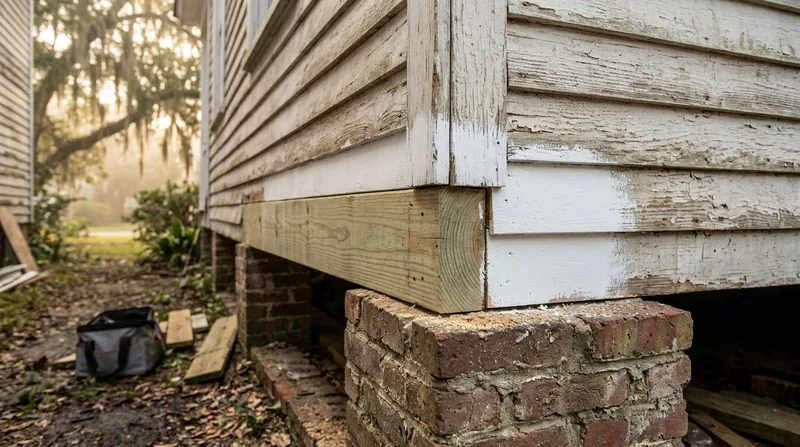




Savannah's hot, humid subtropical climate and high water table make wood rot and dry rot repair a critical maintenance issue for homeowners across the city. From the tall sash windows and deep cornices of Federal townhouses in the Historic District to the gingerbread porches of Victorian Queen Anne homes, and the raised Craftsman bungalows of Ardsley Park, the constant moisture, driven by summer downpours, hurricane-season rain, and tidal marsh seepage, attacks wood at sills, porch floors, column bases, and fascia. We remove decayed framing, siding, and trim, treat the surrounding wood, and rebuild with rot-resistant lumber. It is a permanent repair, not a cosmetic patch. The same carpenters who diagnose the problem do the work, and we explain what the damage is and why it matters before we cut.
Why Wood Rot and Dry Rot Threaten Savannah Homes
Savannah sits on a low bluff above the Savannah River, ringed by tidal salt marsh, with older homes raised on brick piers over damp, poorly ventilated crawlspaces. The enemy here is constant moisture, not freezing cold. Heavy summer downpours soak into wood, and the humidity never fully dries it out. Sill plates, rim joists, porch floors, and window frames decay from the inside out, often invisibly, until the wood becomes soft and structurally unreliable.
- We identify rot by probing suspect areas with a sharp tool to gauge wood density and softness.
- We cut out all decayed wood back to sound timber, treating the surrounding framing with a wood preservative.
- We rebuild with pressure-treated lumber or naturally rot-resistant species suited to the repair location.
- We seal new wood and exposed end grain to prevent future moisture entry.
Early detection and repair prevent costly structural failure and the need for full joist or beam replacement.
Local example: A Victorian home in the Historic District near Forsyth Park may have a rotted sill plate under a bay window where rain has been driven into the wall for years. Replacing just that sill and the first 18 inches of the studs above it costs far less than rebuilding the entire wall, and the house stays sound and dry.
For more on related structural damage, see our termite damage repair page, which covers wood loss from pest activity alongside rot repair techniques.
How We Repair Wood Rot and Dry Rot in Savannah Homes
Our process begins with a close inspection of the affected area and the surrounding wood. We probe joints, check moisture levels, and trace the decay back to sound timber. We then remove all soft, discolored, or punky wood, exposing clean framing underneath. Once the cavity is clear and dry, we treat the exposed wood with a preservative, allow it to cure, and rebuild the section with new lumber matched to the original species and dimension where possible, or upgraded to a more durable alternative.
- We inspect the damage zone using a moisture meter and a sharp probe to establish the true extent of decay.
- We remove all rotted wood and a small margin of sound wood around it to eliminate hidden decay.
- We treat the exposed framing with a wood preservative and allow it to dry fully.
- We cut and fit new lumber, sistering it to the existing frame or replacing the section outright.
- We seal all new wood and caulk gaps to prevent future moisture intrusion.
The repair is permanent because we address the root cause: we remove the decayed wood and prevent future moisture from reaching the new framing.
Real scenario: A raised cottage on Tybee Island has a rotted porch floor joist where water pooled under the deck. We remove the soft joist section, treat the rim board and adjacent framing, sister a new pressure-treated joist to the existing beam, and rebuild the deck subfloor with pressure-treated lumber and proper slope for drainage.
If the structural damage is extensive, we may recommend a full floor joist and subfloor replacement, which we also perform.
| Repair Approach | Description | Best For |
|---|---|---|
| Localized Removal and Rebuild | Cut out the decayed section, treat surrounding wood, and install new lumber sistered or in-place. | Rot confined to one board, sill, or trim piece; structural integrity of the frame is sound. |
| Sister Framing | Install a new joist or beam alongside a partially decayed member, bolting or nailing them together to share the load. | Floor joists or beams with decay in part of the span; the existing member still carries some load safely. |
| Full Member Replacement | Remove the entire rotted board or joist and install a new one, often requiring temporary support posts or jacks. | Decay spans most of the member's length or the wood is too soft to carry load safely; structural integrity is at risk. |
| Trim and Cladding Replacement | Remove rotted fascia, soffit, window trim, or siding; treat the framing beneath; install new exterior material. | Surface rot in trim or cladding; the structural frame is sound and only the weather-exposed layer needs replacement. |
Wood Rot and Dry Rot Repair Cost in Savannah: What to Expect
The cost of wood rot and dry rot repair in Savannah depends on how much wood has decayed, where it is located, and whether the repair involves structural framing or just exterior trim. A small, localized repair to a trim board or sill may start at around $650 to $1,200, while a larger job affecting floor joists or beam ends can run $2,500 to $5,000 or more. The key factors that move the price are the volume of wood to remove, the accessibility of the damage, whether temporary support is needed, and the species and dimension of replacement lumber.
We recommend getting 2 to 3 estimates so you can compare scope, materials, and timeline. Our free estimate includes a detailed walkthrough of the damage, an explanation of what we will repair and why, and a realistic price range. Visit our pricing page for more details on how we structure estimates and what factors affect the final cost.
Catching rot early keeps costs down. A small sill repair now prevents a full joist replacement later.
Wood Rot and Dry Rot Repair Near Me: What Savannah Homeowners Should Know When Hiring a Carpenter
Hiring the right carpenter means finding someone who understands Savannah's moisture challenges, knows how to identify rot before it spreads, and can explain the repair in plain language. Look for a contractor who is fully insured, provides references from recent work in your neighborhood, and is willing to visit your home for a free, no-obligation estimate. Ask whether the same crew will do the work or if it will be subcontracted out. Request a written scope of work that lists what will be removed, what will be treated, and what new materials will be installed.
- Verify that the contractor is fully insured and can provide proof of coverage for liability and property damage.
- Ask for at least two references from homeowners in Savannah or nearby areas who have had similar work done in the past two years.
- Request a detailed written estimate that specifies which boards or framing will be removed, what preservative or treatment will be applied, and what new lumber will be installed.
- Confirm that the contractor understands local building codes and can advise whether a permit is needed for structural repairs affecting floor joists or load-bearing walls.
- Discuss the timeline, material sourcing, and how the work site will be protected from weather during the repair.
A good estimate takes time and includes a site visit. Beware of contractors who quote over the phone or offer a price without seeing the damage in person.
Ready to get started? Contact us for a free estimate at (912) 446-6703. We serve Savannah, Pooler, Richmond Hill, Rincon, Garden City, Port Wentworth, Tybee Island, Thunderbolt, and surrounding areas.
Wood Rot & Dry Rot Repair in Savannah: Pricing Guide
| Service | Price | Details |
|---|---|---|
| Localized trim or sill rot repair | Starting at $650 | Small area, one board or short section of framing, no structural support needed, includes removal and rebuild |
| Floor joist or beam section repair | Starting at $1,800 | Larger decay affecting structural framing, may include sistering or partial member replacement, temporary support often required |
| Full joist or beam replacement | Starting at $3,500 | Entire member is compromised, requires removal of decayed wood, installation of new framing, and proper load support during work |
| Multiple areas or extensive framing decay | On estimate | Crawlspace rot, widespread sill plate damage, or decay in multiple joists requires site inspection to assess true scope and cost |
| Travel and mobilization | Included | No separate charge for service calls within Savannah and surrounding areas, same-day or next-day response available |
| Free estimate | No obligation | Site visit, damage assessment, written scope of work and price range, response within 24 hours at (912) 446-6703 |
Indicative pricing, the exact cost depends on square footage, finish, and site access. Free personalized estimate within 24h at (912) 446-6703.


